

You have two eyes.
Stargazing is better with both.
With a telescope, the actual looking happens in short, squinting bursts through one eye. Binocular telescopes let you relax into the view with both eyes open, so you stay at the eyepiece and wander the sky, bumping into things you've never seen before. Faint nebulae and galaxies show more contrast, too.
Stargazing is a journey. Take the scenic route.
You can stay out with a telescope all night, but the actual looking tends to happen in short bursts. Holding one eye to an eyepiece is uncomfortable, so observing turns into a checklist: find a target, take a quick look, move on to the next.
With both eyes relaxed in a wide field, you stay at the eyepiece and drift. You sweep along the Milky Way, linger on a cluster, and bump into a nebula you didn't know was there. It feels like a discovery, because it is one.
With a telescope
With a binocular telescope
Telescopes were built for one eye. You weren't.
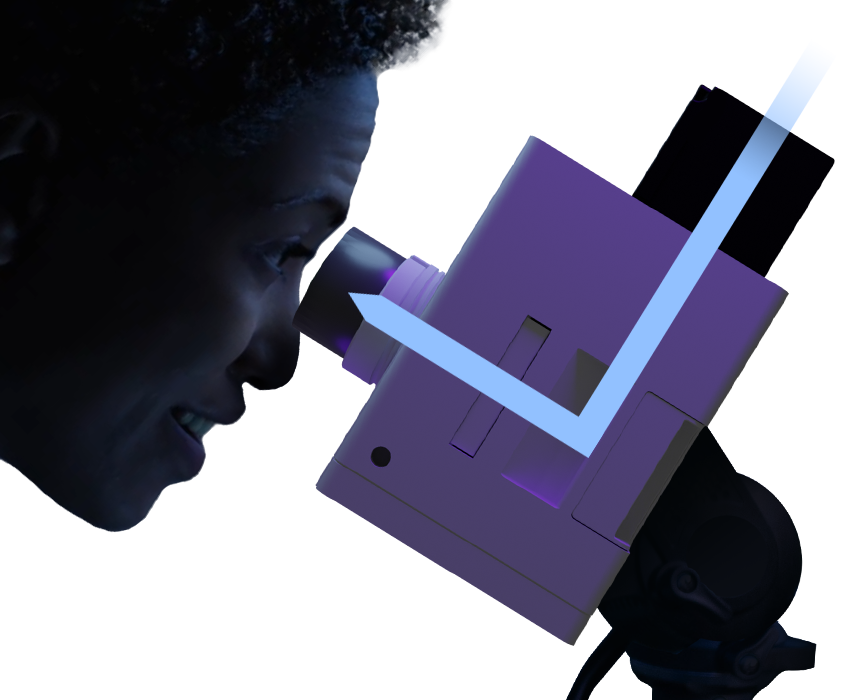
Looking through a single eyepiece means closing, covering or ignoring your other eye. That eye keeps sending your brain a signal it has to suppress, which is tiring. Most people end up squinting and tensing their face, which is why one-eyed looks stay short.
Your visual system is designed to merge two images into one. When both eyes see the same view, your brain gets twice the information, filters out each eye's random noise, and the effort disappears.
Binocular summation: your brain adds the two views together
Vision scientists have measured this for more than 50 years. A review of 65 studies found that two eyes detect faint, low-contrast patterns at least 1.4 times better than one eye, and a large study of 51 observers measured 1.5 to 1.6 times. Faint galaxies and nebula edges are exactly the kind of low-contrast detail that benefits most.
Left eye
A faint image plus its own random noise
Right eye
The same image with different noise, floaters and flaws
Your visual cortex
Adds the matching signal, averages away the noise
One view
Higher contrast on faint nebulae and galaxies, with less noise
More contrast
Dust lanes, spiral arms and the outer glow of nebulae sit right at the edge of what eyes can detect. A 40% or larger boost is often the difference between "something's there" and seeing structure.
Less noise, fewer floaters
Each eye has its own floaters and imperfections in different places. With both eyes on the view, your brain fills in what one eye misses, so the image looks cleaner and steadier.
Relaxed eyes see more
No squinting and no fighting your other eye. A relaxed observer can use averted vision and wait for faint details to pop out, which is how experienced astronomers see the most.
Even stronger in the dark
Research shows the advantage of two eyes grows as light levels drop. Bright, wide-exit-pupil views of faint nebulae at a dark site are where both eyes work hardest for you.
Six reasons people don't go back to one eye
Immersive
With both eyes inside the view, the sky surrounds you instead of sitting at the end of a tube. People describe it as floating in space or swimming in an ocean of stars.
Stay at the eyepiece
You can spend all night outside with a telescope and still only look in short bursts. A 90° viewing angle, both eyes open and a steady tripod keep you comfortable at the eyepiece itself, even at the zenith.
Easy to find things
Magic's widest view covers about as much sky as your fist held at arm's length, so you can aim by eye and wander. A laser pointer puts you on target in seconds, and PiFinder on Heart and Bloom guides you under light-polluted skies, where there are fewer stars to navigate by.
Small binoculars, big rewards
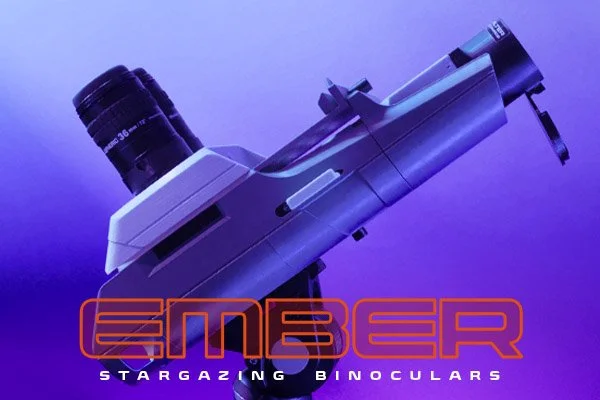
Two eyes, wide views and a relaxed posture make a modest binocular more satisfying than a much bigger telescope. Some of our customers have sold their 12" Dobsonian after building a 50mm Ember.
Quick to set up, easy to store
Put it on a tripod and you're looking in under a minute. Easy setup means you'll actually take it out.
Made to share
Eye spacing adjusts for kids and adults, and merge controls fit most eyes. Many people who struggle with regular binoculars, even with an eye condition, find our designs work for them.
Binoculars, reinvented for the sky
Regular binoculars are made for short peeks at the horizon. Point them up and your neck hurts, the view shakes, and you're stuck at one magnification with no filters. A binocular telescope keeps the two-eyed view and adds what telescopes do well: steady mounting, interchangeable eyepieces and filters, and comfortable right-angle viewing.
| Handheld binoculars | Telescope | Analog Sky binocular telescope | |
|---|---|---|---|
| Eyes used | Two | One | Two |
| Comfortable time at the eyepiece | Seconds overhead | A few seconds | A few hours |
| Steady view | Shakes in your hands | Yes, on a mount | Yes, on a video tripod |
| Change magnification | No | Yes | Yes, 5x to 333x by model |
| 2" wide-field eyepieces | No | Often | Yes, standard |
| Light pollution filters | No | Yes | Yes, standard 2" and 1.25" |
| Finding objects | Easy | Difficult | Easy |
| Setup time | None | 5–60 minutes | Under 60 seconds |
Common questions about binocular telescopes
Isn't one big telescope better than two small ones?
For the same budget, a single larger telescope will reach fainter stars and push to higher power on planets. Two eyes win on contrast, comfort, wide views and time at the eyepiece. Many observers find they see more on a binocular telescope simply because they look longer and more relaxed. If you want both, Bloom puts 8" mirrors in front of each eye.
Are they hard to line up?
The video course walks you through aligning the optics for your eyes, and merge controls on Heart and Bloom let you touch it up in the field with any eyepiece.
Is the image flipped?
Yes, like most astronomy optics. Magic and Heart flip the view horizontally and Bloom vertically. In the sky there's no up or down, and most people stop noticing within a night.
Will they work for my eyes?
Eye spacing ranges cover nearly everyone, including kids, and alignment adjustments help people who've had trouble with binoculars before. If you're unsure, ask us at the Help Desk before you buy.
Do I have to build it myself?
Yes, and that's part of the fun. Our step-by-step video courses need no experience. A 9-year-old is one of the Magic guides. You don't need a 3D printer: Full Kits include every part.
Find the binocular telescope for your sky
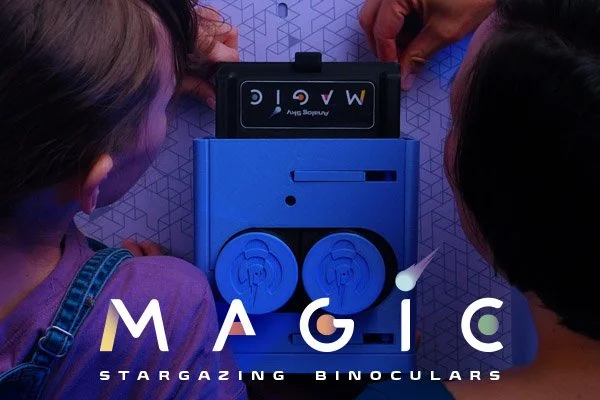
Magic
50mm, ultra-portable. Wide views, 5x to 75x. Great for families and dark-sky trips.
Explore Magic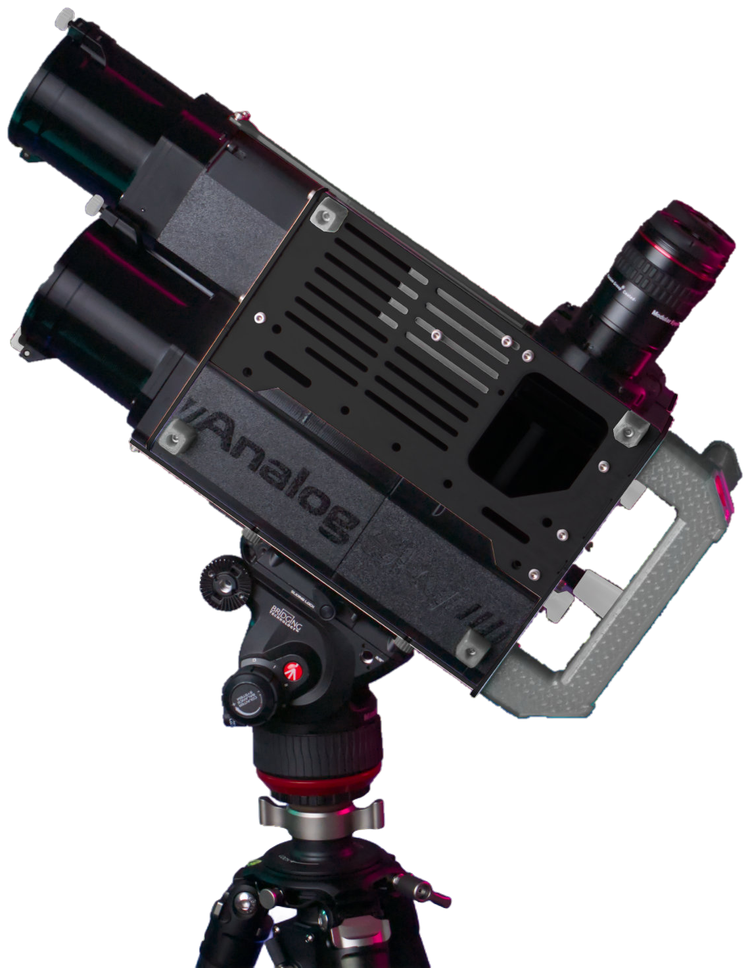
Not on your phone. The actual light, through both eyes.
Join our free members area to watch prototypes develop, see what other builders are spotting, and ask anything about binocular astronomy.
Sources: Baker et al. (2018), "Binocular summation revisited: Beyond √2," Psychological Bulletin; Simpson, Shahani & Manahilov (2009), "Two eyes: √2 better than one?," Acta Psychologica; Schwarz, Manzanera & Artal, "Binocular visual performance with aberration correction as a function of light level."